
# Discrepancy Analysis
Discrepancy analysis is a key data-driven technology in the operation and maintenance of PV plants. It is mainly used to evaluate the consistency and stability of inverter operation, thereby improving the overall efficiency of plants. Its role is mainly reflected in the following aspects:
Fault Diagnosis and Localization: By calculating the dispersion of the inverter's AC-side output power (i.e., the ratio of the standard deviation to the mean of each inverter's output power), devices with abnormally low or high output power can be identified. For example, when the dispersion remains consistently high, it may indicate issues such as inverter faults, communication anomalies, or local shading. The system will automatically alert and locate the faulty inverter, thereby reducing manual troubleshooting time.
Performance Evaluation and Stability Monitoring: The lower the discreteness rate, the more concentrated the output power of each inverter in the power station, and the more stable the operating condition. This indicator can help O&M personnel regularly assess the overall health of the inverter group and promptly detect performance degradation caused by equipment aging or parameter drift.
Power Generation Optimization and Operation & Maintenance Decision Support: In combination with string current dispersion analysis, problematic strings (such as shaded or faulty strings) can be further identified, and targeted technical measures can be implemented (such as adjusting wiring methods or adding power optimizers).
# Operation Method
- Select the specific item for discrepancy analysis: PV input or inverter output.
- Specify the corresponding search criteria.
- View the data analysis result.
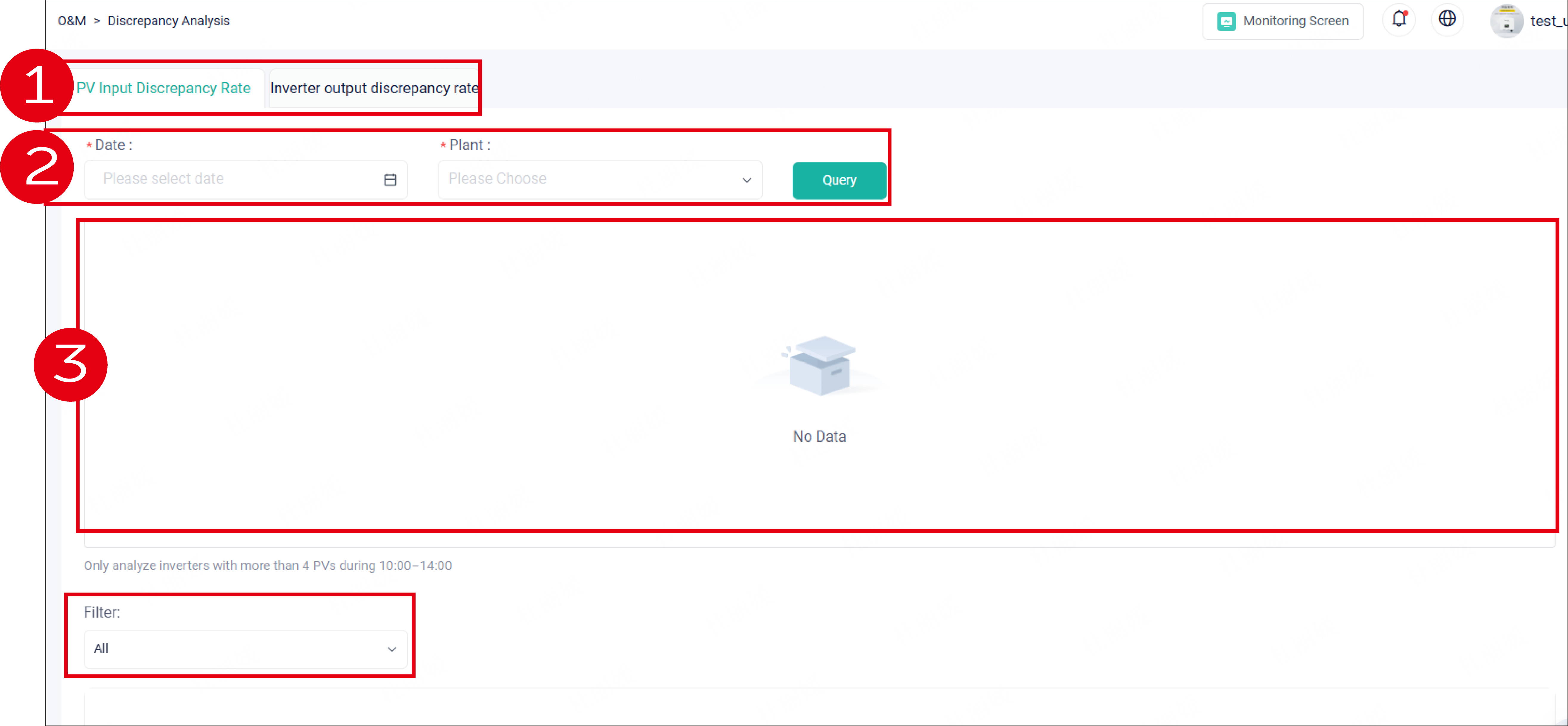
📝 Note: Only analyze inverters with more than 4 strings, and the analysis must be conducted during the optimal sunlight period from 10:00 AM to 2:00 PM.
After completing the discrepancy analysis, you can set a filter value to get the results you want.